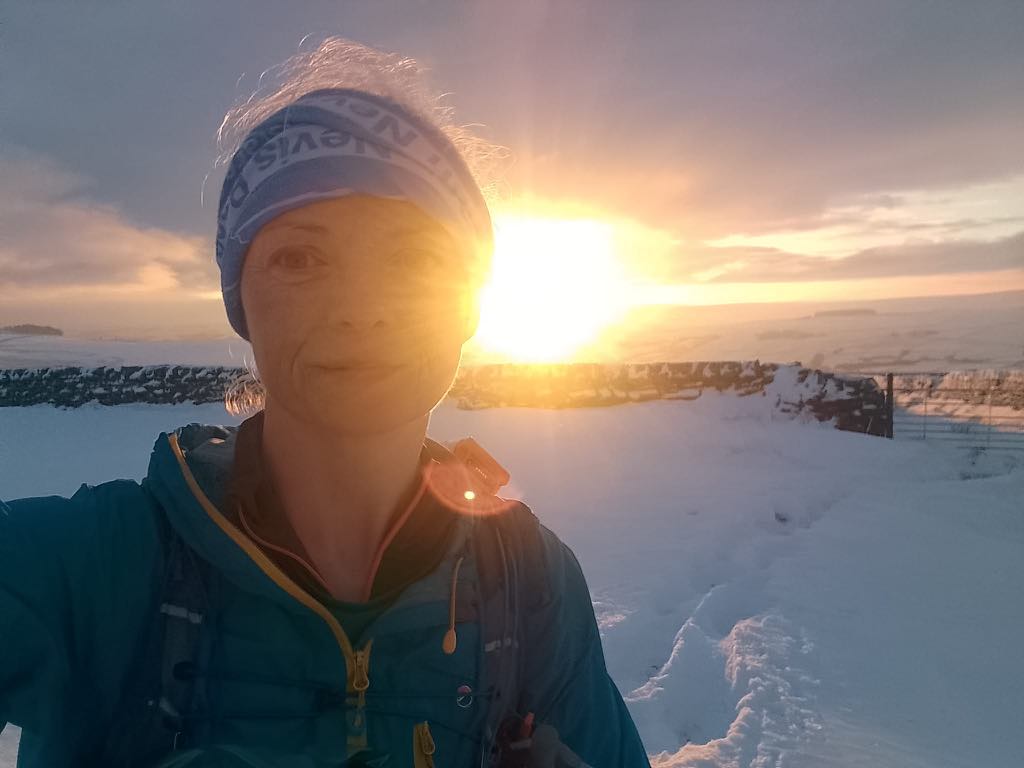
Fiona, who took on this challenge to raise funds for the British Heart Foundation said: “The early parts of the race over Edale, Kinder and Bleaklow were beautiful. We could have been in the Arctic. Blue skies, no wind and just snow everywhere. I don’t think I’ve ever been up there with clear views. It was breath-taking. I shared time with some wonderful runners on and off to Hebden Bridge and I felt pretty positive going into the first checkpoint. I was down on any planned schedule due to the underfoot conditions, but I knew that didn’t matter. It was only once I got out of Hebden and towards the reservoirs that the relentless deep snow started to exhaust me.”
Fiona and Doug crossed the finish line together in 51 hours and 37 minutes, with Fiona finishing 10th in the Women’s category and Doug taking 43rd place in the Open category.

Fiona’s well-earned medal
The Spine Sprint covers the first section of the Pennine Way, 46 miles from Edale to Hebden Bridge, with almost 7,000ft of climbing. Three CVFR members completed this, with Chris Norman and Will Rushworth both securing top ten places. Chris finished 7th in 12 hours and 8 minutes, with Will following less than half an hour behind to claim 10th place.
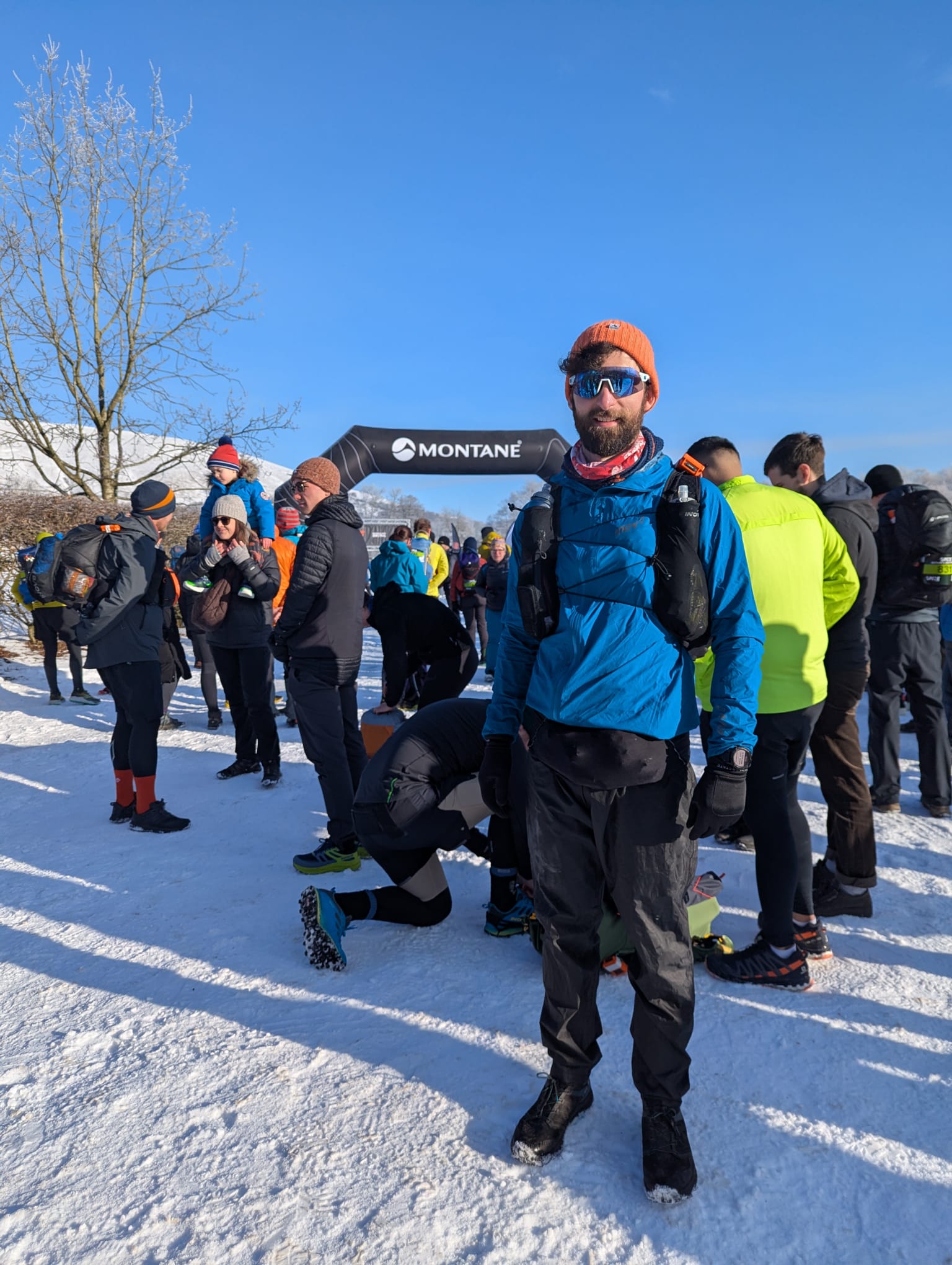
James raring to go at the start of the Sprint
James Sackley felt excited and physically well-prepared for the race, but found that the snowy conditions on the ground made it mentally challenging, as well as posing a variety of kit and clothing conundrums. Acknowledging that he may have set off too quickly, he struggled through a demoralising middle stretch, saying “I ran the sections I could, but a lot became a death march”. He found his “rocket fuel” again in the final few miles, however, stepping up the pace to finish in 36th place in 14 hours and 50 minutes. James came away with many valuable lessons that he has shared in his own full report on the race (included below).
North Cornwall trail half marathon
This winter, CVFR’s Joe Nerini has been ticking off some coastal trail half marathons organised by Endurance Life. Having previously completed their North Yorkshire Moors and Gower Peninsula events, this week he headed to North Cornwall for his third event in this series.

Joe racing in Cornwall
Joe writes: “I’m really enjoying this series as it’s taking me to beautiful places in the UK that I’ve never visited before. The races are flagged but the routes can be fairly technical and there are a lot of up and downs, so it’s a nice mix for me to improve fitness over winter without worrying too much about navigation.
“North Cornwall was absolutely stunning – choppy seas and steep cliffs are a great backdrop for a race event. There was about 3,200ft of climbing but it was well spread across the course so I don’t remember any single killer climbs. I came across the line 67th out of 126 finishers, with a time of 2:50:41.
“I’m looking forward to my next one which is in the Peak District in February. They have a leaderboard for the 2024-25 season, with the best four results counting for each participant. I’m watching with interest as I’m currently in 3rd place overall! And I’m still debating whether to do a fifth event before the end of the season.”
Racing into 2025
A couple of Calder Valley stalwarts were in action as 2024 bumped into 2025. Manhar Patel was one of a large field of almost 300 that ran the Wormstones Fell Race in Glossop on New Year’s Eve. Manhar completed the four-mile route in a time of 64:28.
New Year’s Day saw CVFR’s Stephen Smithies quickly shake off any festive hangover to take on the Nine Standards Fell Race that takes place in the hills above Kirkby Stephen. Stephen managed 24th place in a field of 128 runners, completing the eight-mile race in a time of 1:08:13.
“A lot to process and learn from”: James Sackley’s Spine Sprint experience
Thanks to James for sharing this in-depth account of the highs and lows of his epic South Pennine slog.
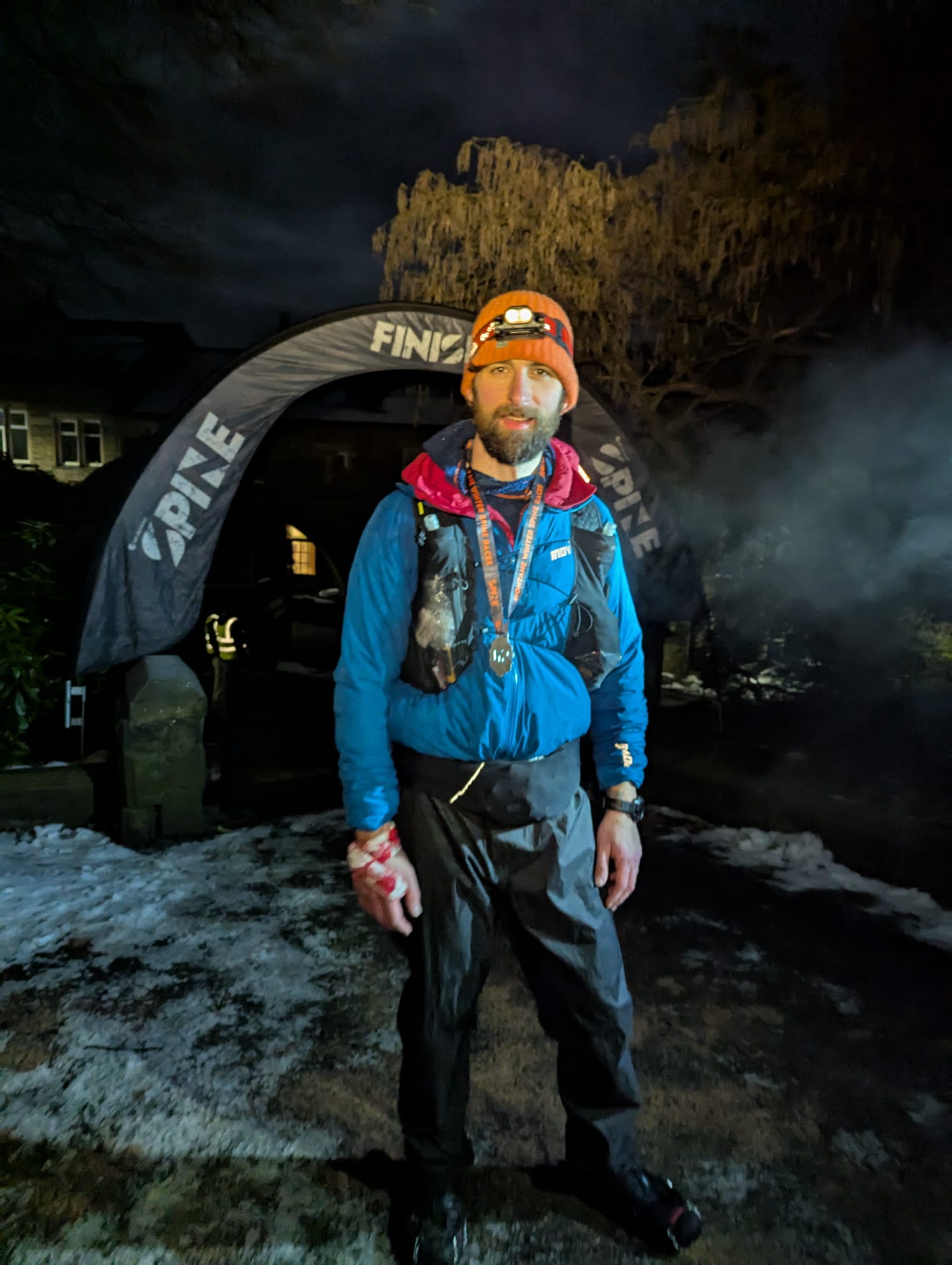
James at the finish after 46 gruelling miles
OK, let’s talk about context first and “influencing factors” in my mood. I was extremely excited on race day and eager to get going. However, the days/weeks before had taken a toll. The training has been excellent, and I wouldn’t have changed anything. It definitely got me in the best fitness I’ve ever been in. But with having to shovel our way out of the house because of the snow days before the race, freaking out about getting a bivvy bag in time, it all played a part in me not being mentally in a good place (which I hadn’t prepared for, and it is so important to do that mental check-in before race day). If not done, those gremlins will get you! But the most important thing I did not do, which genuinely messed up my race from a mental standpoint, is totally agreeing with Jen regarding picking me up at the end. She’d jokingly said, try to finish by 12…but I thought that was serious, and it basically made me panic for all the race because I knew I wasn’t going to do that. She actually knew it would take me longer and didn’t mind at all, and had prepared for that, but I hadn’t squared that up in my head. So I ended up finishing at 3am. Still 36th of out 110, with 25% not finishing. OK, so that’s the context…
OK, start line. I stood there and I said to Jen “I am standing here and feel too comfortable, I think I’m wearing too many clothes”. Personally, if it is cold and I’m on the start line and don’t feel the cold at all, I definitely have too many clothes on. But I ignored it, mistake number 1. We went off, and I felt comfortable leading the pack. This potentially was mistake number 2, going off too quickly. Its 0.6 miles of flat road before you hit the Pennine Way and begin to climb. The benefit of going off quicker is I never got stuck behind anyone, and there were no bottlenecks, so that was a bonus as there were gates to get through, which could have slowed me down. Not long into the race, I realised I was absolutely dripping with sweat, pouring down my sunglasses and couldn’t see very well. I again ignored it and figured we’re climbing up high, and it’ll get cold, and I’ll just need to put my jacket on again. Finally, I got to Jacob’s Ladder, and a quarter of the way up, I realised I needed to sort myself out. I took the jacket off, wearing a t-shirt and warm base layer, and put on my crampons as it was super icy and snowy. These were a lifesaver and didn’t come off for the whole race. I instantly felt better taking off the jacket and could breathe.
Looking at Strava, this was 45 minutes into the race, and in my opinion I had done a serious amount of damage to myself already. Fatigued because of being too hot, but also losing so much salt! I had brought salt tablets with me, but I don’t think I took one until over 5 hours?!?! Even though I’d been cramping up immensely beforehand. Note to self: CHECK IN WITH YOURSELF!!! “Is something wrong, what is it, can I fix it, if not – why?” But also, if you’re just tired, and it is no more than that, have the tools to stop the demons taking over. At least I started to take on salt later, which made a huge difference, and cramps went mostly away.
A “running” theme was that I was getting very frustrated with being unable to run many of the flat or gradual climbs because I felt it so hard going with the deep snow! Even if it were trodden down, it would be one foot below the level of snow as a hole, and basically stepping hole to hole. It was just so demoralising. But again, I wasn’t using any of my mental tools to “enjoy” it at all. I just kept going deeper and deeper into a hole of feeling sorry for myself. But I kept trucking. I ran the sections I could, but a lot became a death march. According to Garmin, I walked the majority of the race, and I believe that. I think the damage I did to myself at the start of the race had much to do with this.
Generally, I fed and watered myself pretty well. I took every opportunity to fill my bottles in streams and the Mountain Rescue Team points. I ate OK, but my energy levels would have been better if I had eaten more. I need easier, not chewy, savoury things. Like Marmite sandwiches. Something for next time.
Coming into about 10 miles to go, which is where it is flat / downhill to the end, I was going over and over the fastest way to get home – i.e. is it quicker to quit and get a ride back and see Jen earlier, or just keep going? I really couldn’t decide. Thankfully I’d sent a few voice notes to Jen, and she’d realised I wasn’t in a good way, and she messaged saying how well I was doing, in 35th place ish, and she could see my ETA so to keep going. Basically, that was game-changing – it put rocket fuel into me, and I started to actually pass people, and I ran as much as my body would let me.
There is a lot to process and learn from after this race. If I’d implemented the plan and had myself together better, I would have had a fantastic time out there. The weather was perfect, with no wind, snow or rain. It started to get cold, but I had plenty of clothes to get me warm and looked after myself later in the race. I do have a question mark: whether poles would have helped me, possibly… a lot of people had them; I just wasn’t sure in deep snow whether they’d do anything. But potentially they would have kept my balance better and driven my force forward more efficiently.
I had come away from this thinking never again. But, that’s not true. I think the Challenger South (108 miles) in the summer of 2026 could be a good shout. But time will tell. For now, I’m excited about getting out into the fells for shorter stuff for a while. But won’t be running for a week or two.